Posts

Image
  ENTRY 10 THE 7th CHORD IDENTIFYING FIGURED BASS NOTATION & LEAD SHEET SYMBOLS FOR 7th CHORDS  * Other than using notes in the staff there are other ways to identify 7th chords and their inversions. This can be done by using the figured bass notation and the lead sheet symbols. F igured bass notations are placed just below the bass clef staff while lead sheet symbols are above the treble clef staff .  * Figured bass uses roman numerals followed by numbers as notations to identify the 7th chord. I am going to explain how they are arranged along with the quality and type of  7th chords they  represent in the diatonic .  * A major, major first degree 7th chord of a major-scale in root position is identified by I 7/5/3, I 7/5 or 7 in the first inversion, it is I 6/5/3 or I 6/5, second inversion, I 6/4/3 or I 4/3 and third inversion it is I 6/4/2 on I 4/2 * A major, minor 5th-degree 7th chord of a major-scale in root position is identified by V7/5/3, V7/5 o...
Image
 ENTRY 9 THE 7th CHORDS Part 1 * The 7th chord is made-up of an additional note above the triad, the  notes arranged with an interval of a third between them. The  distance between each third determines the chord quality.  There are five types of 7th chord qualities that I will explain along with how they are arranged. * Beginning with the ' major minor 7th', this is also the dominant 7th chord, it is identified as Mm7 or by using the 'letter name' of the root note before the number 7, e.g. C7. From the root note, this chord has a major triad and a minor 7th. This chord is diatonic of the 5th degree  in major-scales and also the 5th degree   in minor-scales .   * The 'major, major 7th' chord is identified as Maj7 or by using the 'letter name' of the root note before with M7. This chord has a major triad and a major 7th from the root.  This chord is diatonic of the 1st and 4th degree  in major-scales and the 3rd and 6th degree   in minor-...
Image
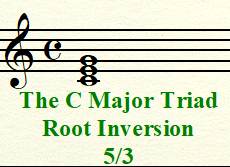
ENTRY 8 Figured Bass and Lead-Sheet Symbols * Triads can be arranged in three positions   and these are called root position, first inversion and second inversion. These inversions can be identified in figured bass and lead-sheet with the use of various symbols. * Having a triad in root position, the root note is in the bass, for example, the C major triad, in root position the C would be the bass note with E and G above it. This is made up of a major third and a perfect fifth from the bass note. The symbol used in  this inversion for figured bass is 5/3 and the lead-sheet, a capital C .   * The first inversion would have the third degree of the triad in the bass, for example, using C major E would be in the bass with G and C  above it. This is made up with a minor third and a minor sixth from the bass note. In this inversion, the figured bass used 6 or 6/3 and the lead-sheet used C/E. * In the second inversion, the fifth degree of the triad is in the bass with ...
Image
ENTRY 7  Triads * Triads are made up of three notes, once in root position, the bottom note is the root note and the notes above it is a third and a fifth from the root. * In root position, the fifth can either be perfect, augmented or diminished, an augmented fifth, is made up of two major thirds and a diminished fifth, is made up of two minor thirds. The triad of a perfect fifth can either be major or minor, the major triad is consist of a major third at the bottom while a minor triad is made up of a minor third at the bottom.    * In a major scale, all of the notes can be used to build triads. Once all of the notes are belonging to the scale the first, fourth and fifth degree, are major triads and the second, third and sixth, degree are minor triads while the seventh degree is a diminished triad. * The notes of a minor scale can also be used to build triads, This time the first, second and fourth are minor triads and the third, fifth and sixth are major triads while th...
Image
  LESSON 6 INTERVALS * In music intervals are the distance between any two notes.  * There are two ways in which intervals are constructed, either harmonically or melodically. The construction of harmonic intervals are a note above the other's and the melodic intervals are one note after another. * Intervals are made up of two parts the numbe r and the quality . The numeric calculation of intervals begins with the letter name of the bottom note and it involves all of the other letters leading up to the top note, including the top note. For example, using C as a bottom note and G as the top note, the notes involved are C, D, E, F and G which includes 5 letters the numeric value is a 5th. The quality of these intervals can either be major, perfect, minor, diminished or augmented. To recognize the quality of a major interval, the top note of the interval must be belonging to the scale of the bottom note and it should be either a 2nd, 3rd, 6th or 7th degree. When a major interval ...
Image
  ENTRY 5 THE DIATONIC MODE About the diatonic scale, it has seven modes in each of them the tonic note is those that come from the major scales. Each one of these modes has it's own name, beginning with the first degree of the major scale which is the Ionian and next is the Dorian, Phrygian, Lydian, Mixolydian, Aeolian and the Lucian. In each mode, the tone/semitone patterns arranged differently, creating a different sound in each scale mode. Furthermore, the Ionian mode is known as the major scale and the Aeolian the minor scale.  Each one of these modes has it's own chord, some of the chords made up of different triads such as the Ionian, Lydian and Mixolydian that are major the Dorian, Phrygian and Aeolian are the minor triads and Lucian the only one that is a diminished triad.   The Seven Mode of The Diatonic Using C Major Mode   Degree of The Scale Tone/Semitone Pattern Scale Ionian Major Scale 1 st T T S T T T S C D E F G A B C Dorian   2 nd T S T T T S T...
Image
  ENTRY 4 Minor Scales * To each major scale there is a relative minor and the relative minor scale begin with using the 6th degree of the major scale along with the same accidentals. * There are two additional forms of the minor scales and they are the harmonic minor and the melodic minor. * The harmonic minor forms when the 7th degree of the minor scale is taken a semitone higher ascending and descending.   * The melodic minor forms when the 6th and 7th degree of the minor scale is taken a semitone higher ascending only when descending, the 6th and 7th degree is lower by a semitone which is the notes of the natural minor.   * The minor scale also has its parallel major scales, these scales have the same tonic note but the third, sixth and seventh degree of the minor scale is lower by a semitone.  This is the A Minor scale which is the relative to C Major   Parallel Minor Scales to C Major This is a melody by Chopin it is in the key of A minor and it has a...